

DHT LAW FIRM PARTICIPATES AS A REPRESENTATIVE AT THE NATIONAL CONFERENCE ON LAW IMPLEMENTATION AND LEGAL REFORM
As Vietnam enters a period of profound transformation, sweeping changes are taking place across various aspects of social life - including the legal system. July 1, 2025 marked a significant milestone as the country officially transitioned to a streamlined two-tier local government structure with 34 provinces and municipalities. Alongside this restructuring, the Constitution as well as numerous laws, decrees, circulars, and resolutions have undergone adjustments and amendments.
These developments introduce new requirements for compliance, internal processes, and operational structures across agencies, organizations, and sectors. In this context, staying timely and well-informed about changes in current legislation is essential to ensuring transparent and effective implementation.
Recently, DHT Law Firm was honored to be recognized as one of the reputable and high-quality legal service providers invited to participate in several sessions related to legal implementation and draft law amendments. These include the “Workshop on the Implementation of the 2024 Notarization Law” (held on June 30) and the “Workshop on Consultation for the Draft Law on Civil Judgment Enforcement (Amended) 2025” (held on July 4), both organized by the Democracy and Law Journal under the Ministry of Justice.
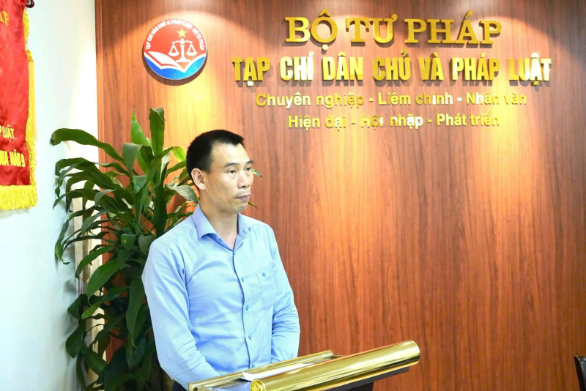
Mr. Truong The Con, Editor-in-Chief of the Democracy and Law Journal
Both workshop sessions were chaired by Mr. Truong The Con, Editor-in-Chief of the Democracy and Law Journal, with co-chairmanship by Mr. Nguyen Tan Cuong, representative of the Department of Judicial Support, during the June 30 session. The workshops were attended by representatives from the National Assembly’s Committee for Legal and Judicial Affairs, the Supreme People’s Procuracy, and the Office of the National Assembly; representatives of several units under the Ministry of Justice; as well as delegates from civil judgment enforcement agencies, provincial and municipal People’s Committees, Departments of Justice, People’s Courts, People’s Procuracies, notarial practice organizations, law firms, and others—participating both in person and online.

Mr. Nguyen Tan Cuong, Deputy Director of the Department of Judicial Support
In their remarks, the delegates focused on discussing and clarifying key issues related to the notable new provisions of the revised and draft laws compared to the previous versions; identifying urgent matters arising during the implementation and amendment process; recognizing potential difficulties and obstacles; and proposing practical solutions to address them.
Based on its participation in and review of the workshop discussions, Dai Ha Thanh Law Firm offers a consolidated analysis with the aim of providing a valuable reference source for individuals, organizations, legal practitioners, and stakeholders interested in significant developments in the current legal system as well as future directions for legislative adjustments.
1. Urgent Issues, Challenges, and Proposed Solutions Discussed at the Workshop on the Implementation of the 2024 Notarization Law

Representative of DHT Law Firm – MSc., Lawyer Bui Thi Hong Ngoc
1.1. On notarization procedures
The 2024 Notarization Law introduces several new requirements aimed at enhancing authenticity and transparency in notarization activities. One notable provision emphasized during the workshop is the requirement that the signing of notarized documents in the presence of a notary must be “photographed and stored in the notarization dossier” (Clause 1, Article 50 of the 2024 Notarization Law).
Many participants noted that this regulation requires clearer guidance. From a technical standpoint, the workshop highlighted several challenges regarding the standards for photographs taken during the notarization process. Various practical scenarios may arise—especially when notarization takes place outside the notary’s office, such as at police stations, temporary detention facilities, or other locations where recording is restricted, or when the person requesting notarization does not consent to being photographed.
The proposed solution emphasized a flexible and context-appropriate approach, relying on the professional judgment of the notary. Under the law, the photograph must allow identification of the notary and the person requesting notarization at the time the transaction is performed; however, it does not need to capture the detailed content of the document.
For cases where photographing is objectively impossible, the notary must retain suitable evidence (such as images of “no photography” signs, audio recordings of explanations, etc.) in the notarization dossier. At the same time, the notary should clearly explain to the requester that the recording of images is intended to safeguard their own lawful rights and interests.

Regarding the provision on maintaining the Register of Notarization Requests, Clause 9, Article 36 of the 2024 Notarization Law states: “Maintain the register of notarization requests, notarization registers, other registers, and store notarization dossiers in accordance with the law.”
In practice, the operation and management of this register reveal several shortcomings. Questions were raised regarding who is responsible for entering and managing the register, when information must be updated, and how to ensure consistency between the data recorded and the actual timeline of events such as receiving, processing, or rejecting notarization requests. At the workshop, several participants noted that notarial practice organizations are currently developing and managing their own registers and coordinating assignments internally. However, these issues demonstrate the need for clear and uniform guidelines across the entire system to ensure legal consistency, procedural coherence, and transparency.
In addition, the workshop highlighted several new regulations, such as: Certification of translators’ signatures on translations (Point c, Clause 1, Article 18 of the 2024 Notarization Law); Storage of notarization dossiers in electronic form (Clause 1, Article 59 of Decree No. 104/2025/ND-CP dated 15 May 2025, detailing several provisions and implementation measures of the Notarization Law); Conditions for appointment and dismissal of notaries (Articles 13 and 16 of the 2024 Notarization Law); The requirement to build a unified and effective national notarization database (Article 57 of Decree No. 104/2025/ND-CP dated 15 May 2025).
1.2. On the Socialization of Notarization Activities
The 2024 Notarization Law reflects the spirit of promoting the socialization of notarization services and ensuring their sustainable and stable development. The Law allows notarial organizations to operate as private enterprises at the district level, as regulated by the Government. It also continues to provide a roadmap and detailed regulations for converting or dissolving state-run Notary Offices.
However, a notable point raised at the workshop concerns the socialization of notarization activities and the positioning of the notarial profession, particularly in relation to the proposal to establish Real Estate Transaction Centers (RETCs).
The objectives of RETCs, as outlined in the Draft Proposal, raise several issues requiring clarification—especially the potential overlap in functions between these centers and notaries in handling real estate transactions.
According to the Draft Proposal, RETCs would be responsible for examining and assessing the legality of real estate supply sources, land use rights, and certifying contracts for the sale and transfer of real estate or land use rights—as a substitute for notarization or certification of such transactions. However, these functions are not provided for in the current Notarization Law.
Additionally, the Draft Proposal grants RETCs the authority to handle nearly the entire process of real estate transactions, including tasks traditionally performed by several different agencies—among them, tasks belonging to notarial practice organizations. Specifically, the Draft states that RETCs may “certify” transactions via text messages or written confirmation, and such certification would have “legal validity for the transaction.” This would mean that transactions or contracts required by law to be notarized or certified would no longer require notarization if signed at the RETC (as referenced in Official Dispatch No. 4109/BTP-PLDSKT dated 10 July 2025 of the Ministry of Justice seeking comments on the proposal).
Given the proposed scope of authority, workshop participants emphasized that the role of notarization in ensuring the legality of transactions and preventing legal risks cannot be diminished. Delegates stressed the need to clearly define the functions, powers, and legal status of RETCs to prevent conflicts or the erosion of the role of notaries.
To safeguard the position and unique function of the notarial profession within the legal system, delegates recommended strengthening the advocacy role of professional organizations—particularly the Vietnam Association of Notaries and local notary associations—to ensure the profession’s collective voice is effectively represented.
2. Key New Provisions and Contributing Opinions at the Workshop on the Draft Law on Civil Judgment Enforcement (Amended) 2025
View the latest Draft Law on Civil Judgment Enforcement 2025 here.
2.1. Certain Provisions on Statutes of Limitation
The Law on Civil Judgment Enforcement and its implementing instruments have prescribed time limits for most enforcement procedures. In line with the requirement to shorten procedural timelines and reduce costs, the Draft Amended Law revises and supplements relevant provisions, with the aim of reducing the time and expenses associated with enforcement activities. Regarding the statute of limitation for requesting judgment enforcement, the 2025 Draft law maintains the five-year period, which is generally consistent with the current law. However, this provision attracted considerable attention during the workshop. Pursuant to Resolution No. 27-NQ/TW, several delegates observed that the five-year limitation period for parties to request enforcement is relatively long and does not align with the objective of saving time and resources. Therefore, delegates proposed reducing the period from five years to three years.
As for the statute of limitation for complaints, Article 90 of the 2025 Draft Law on Civil Judgment Enforcement classifies complaint subjects into three groups:
(i) decisions and acts relating to enforcement prior to the issuance of decisions on securing or coercive measures;
(ii) decisions and acts relating to the application of securing measures;
(iii) decisions and acts relating to the application of coercive measures and decisions issued after coercive measures have been applied.
These three groups correspond to three distinct complaint time limits. To address the prolonged duration of complaint resolution—which negatively affects the organization of judgment enforcement—some delegates recommended consolidating the three groups into a single uniform time limit and shortening it to ten days.
2.2. Certain Provisions on Securing Measures in Civil Judgment Enforcement
Compared with the 2008 Law on Civil Judgment Enforcement, Clause 1 Article 42 of the 2025 Draft law adds a new provision on exit suspension as one of the securing measures. However, some opinions argue that this measure is not truly necessary, as suspending exit effectively restricts the judgment debtor’s freedom of movement and may adversely affect their business and livelihood. Consequently, the judgment debtor may face greater difficulty in mobilizing financial resources to comply with the judgment, which, in turn, could prolong the enforcement process.
2.3. On the Socialization of Civil Judgment Enforcement Activities

To institutionalize the policy of “socializing certain civil judgment enforcement activities with appropriate safeguards and a suitable roadmap” in order to meet the country’s development needs in the new context, Chapter III, Clause 4 Article 98 of the 2025 Draft Law on Civil Judgment Enforcement provides: “Rename the title ‘Bailiff’ (Thừa phát lại) to ‘Enforcement Officer’ (Thừa hành viên); rename bailiff practice organizations as civil judgment enforcement practice organizations; and rename Bailiff Offices as Civil Judgment Enforcement Offices.” The workshop noted that the majority of delegates agreed with this renaming proposal, as it accommodates the need to expand the participation of the private sector in judgment enforcement activities.
According to Article 83 of the 2025 Draft Law on Civil Judgment Enforcement regarding the powers of Enforcement Officers, Enforcement Officers are authorized to: verify enforcement conditions upon request; in cases where the parties provide verification results conducted by an Enforcement Officer, the civil enforcement officer shall not be required to re-verify unless deemed necessary; issue notifications on civil judgment enforcement; directly organize the enforcement of cases upon request; and perform other tasks as prescribed by the Government. Comments at the workshop emphasized that, when organizing enforcement activities, the head of a Civil Judgment Enforcement Office and Enforcement Officers are granted powers nearly equivalent to those of state enforcement officers, except for tasks involving public authority, such as: imposing administrative penalties; using supporting tools; and, in cases where coercive measures require mobilization of enforcement forces, obtaining prior approval from the competent authority before issuing a decision on coercive enforcement.
At the conclusion of the workshop, experts affirmed that promoting socialization does not mean the State relinquishes its central role in safeguarding justice. On the contrary, it necessitates enhanced oversight and clear delineation of which state bodies are responsible for supervising enforcement activities and strictly addressing violations committed by private-sector actors entrusted with delegated powers. Representative of the Department of Civil Judgment Enforcement Management, Ms. Nguyễn Thị Kim Quy, stated that the agency will continue to consolidate the workshop’s inputs and finalize the Draft Amended Law on Civil Judgment Enforcement for submission to the National Assembly at its upcoming session. The overarching objective is to develop a legal framework that not only aligns with practical realities but also meets the requirements of judicial reform in the current period of national renewal.
The two recent thematic workshops shared the common objective of clarifying major policy orientations in the implementation of the law and addressing practical challenges to ensure consistency and effectiveness in enforcement. With a spirit of proactivity, responsibility, and professionalism, DHT Law Firm reaffirms its commitment to continuing its support for the legal reform process, consistently enhancing the quality of its legal services, and contributing its professional expertise in assisting and accompanying individuals, organizations, and enterprises—thereby safeguarding, to the greatest extent, the lawful rights and interests of its clients across all areas of operation.